
What Now? Series #4 | Unlocking Your Potential: Overcoming the Silent Ceiling of Inner Narrative
Have you ever felt stuck in your career, unsure of how to move forward?
You may be standing at the edge of a new chapter, wanting change, yet feeling strangely unable to move. Not because you lack ability, but because of the story quietly repeating in your mind.
You’re not alone. Often, for many of my clients, the greatest obstacles they face are not external, but rather the quiet stories that play in their minds, limiting their potential and stifling their growth.
So, the biggest barrier to your next chapter may not be external circumstances, but the inner narrative you no longer question.
You might be assuming that what holds you back is outside you, such as timing, responsibilities, age, money, family expectations, uncertainty, or a lack of opportunity. Sometimes those factors are real. But often, something is happening behind the scenes.
It is the sentence that keeps playing in the background.
The assumption you no longer notice.
The private script that has been shaping your choices for years.
And because it feels familiar, it begins to feel true.
Why Inner Narratives Matter
Inner narratives shape perceptions, beliefs, and, therefore, behaviors. Over time, a repeated thought will become an inner script and a belief.
It feels so true that you stop examining it. It may sound like this:
- “I am not the kind of person who does that.”
- “People like me should be grateful and stay where they are.”
- “If I change direction now, it means I failed.”
These are not objective truths. They are stories, often inherited, absorbed, or reinforced over time. Some of these beliefs were formed in childhood or shaped by culture, family expectations, professional environments, or past disappointments. Some began as protective interpretations in difficult moments and stayed long after they stopped serving us.
The danger is not only that you may believe these stories, but that they also gradually start to shape your life without you noticing.
I’ve seen people who DO NOT:
- apply for the role.
- start the conversation.
- ask for help.
- name what we really want.
Not because they were incapable, but because the story has quietly become their limitation.
This idea is also supported by psychology. Aaron Beck’s Cognitive Behavioral Theory shows that thoughts, feelings, and behaviors are deeply interconnected, so repeated beliefs can directly shape emotional responses and actions. Martin Covington’s Self-Worth Theory suggests that people may sometimes avoid effort or change in order to protect their sense of worth. And Ryan and Deci’s Self-Determination Theory reminds us that when our needs for autonomy, competence, and connection are blocked, we may unconsciously fall into self-limiting patterns. In other words, these stories do not just live in the mind. They influence how we move through life.
Identifying the Interference
These inner narratives or beliefs also create invisible interference.
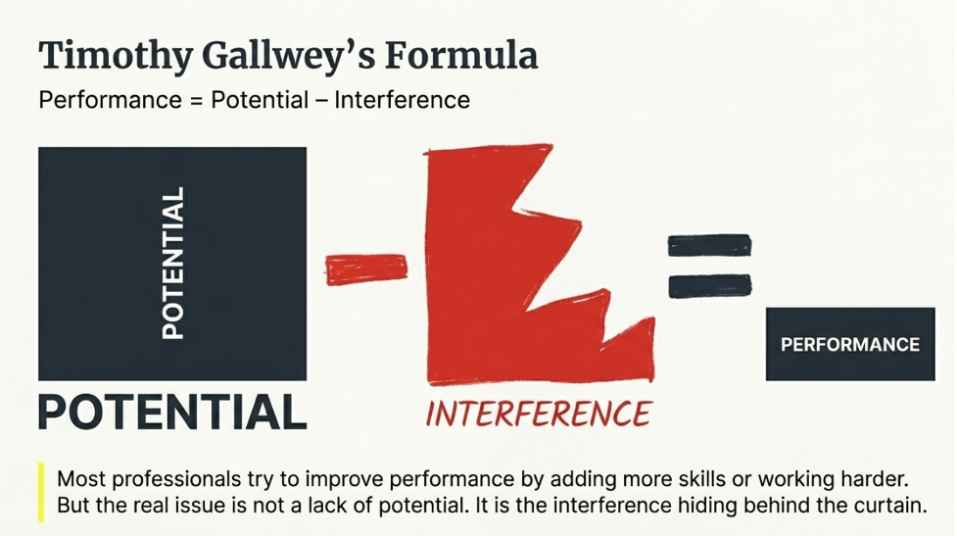
I love how Timothy Gallwey presented this formula that became well known and offers a powerful lens:
Performance = Potential – Interference
Many people assume they need more effort, more confidence, or more clarity. Most professionals try to improve performance by adding more skills, working harder, or pushing themselves further. Lifelong growth matters, of course. We should continue developing ourselves.
But often that is not enough.
Because the real issue is not always a lack of potential. Often, the real issue is interference.
The more effective path to a meaningful next chapter is not only to build capacity but also to identify and reduce the interference that continues to limit performance. That interference is often internal: limiting beliefs, quiet assumptions, self-doubt, fear of judgment, harsh self-talk, guilt, or old identities we have not yet outgrown.
Your potential is often already there.
What holds you back might be the interference that hides behind the curtain.
And that’s what I have observed in my clients: they don’t always need a dramatic reinvention. Often, they need to notice these invisible beliefs already steering their choices and holding them back.
Unquestioned assumptions that shape the beliefs
When people hear the phrase “limiting beliefs,” they sometimes think of obvious, dramatic statements. But in real life, the stories that shape them are often socially acceptable.
- Someone wants to change careers but keeps telling herself, “I have invested too much to start over.”
- A leader longs for a more meaningful life, but tells himself, “This is just a phase. I should push through.”
Many of the assumptions that shape their lives sound almost reasonable:
“I am too old to change.”
“I need everyone’s approval before I move.”
“Wanting something different means I am ungrateful.”
“I have to be certain before I act.”
“If I slow down, everything will fall apart.”
These beliefs are just unquestioned assumptions that become silent ceilings.
And what happens is that they start to influence what people tolerate, postpone, or never allow themselves to imagine.
This is especially true for high-functioning professionals. People who are capable, responsible, and outwardly successful often do not recognize how much their lives are being organized around an old internal story. They keep performing, keep delivering, keep meeting expectations, yet feel increasingly disconnected from themselves. Not because they lack strength, but because they are still living inside a belief that no longer fits who they might even become.
Rewriting Your Story
Sometimes it is an old protective voice that once tried to keep you safe. It might be a fear-based voice, trying to protect you from embarrassment, rejection, or uncertainty. Or it might be a socially conditioned voice, shaped by messages about who you should be, what you should want, or how much space you are allowed to take.
On the other hand, there is a wiser and more grounded voice. That voice does not flatter you or shame you. It does not push you into perfection or paralysis. It simply tells the truth with more honesty and more compassion.
Learning to distinguish between these voices matters. It is not replacing every difficult thought with a cheerful slogan. But it is more questioning, challenging the first voice and replacing it with an empowering voice.
The real work is not to dismiss your fears, but realistically change your narrative, that might sound like this:
| From | To |
| “It’s too late for me.” | “I may not be early, but I am not too late to begin honestly.” |
| “I should be able to handle this alone.” | “Needing support does not mean I am failing.” |
| “If I do not know the whole path, I cannot start.” | “I only need enough clarity for the next step.” |
| “Wanting something different means something is wrong with me.” | “Wanting something different may be a sign that I am growing.” |
| “If I disappoint others, I have done something wrong.” | Disappointing others may sometimes be part of being true to myself.” |
This is where change begins. Not necessarily with a dramatic decision, but with a grounded sentence.
Sometimes your next chapter does not begin with a major leap. It begins with noticing the story you have been living inside and choosing not to hand it the pen anymore.
Some questions to carry with you
- What sentence plays in your mind most often? Is it fully true?
- And how can you rewrite it?
- What inner narrative have you rewritten, and how has it positively impacted your journey?
Take a moment today to notice your most persistent inner story. Write it down. Challenge its truthfulness. Then, draft a new story: one that sets you free, instead of holding you back.
If this resonates, I’ve created free resources and reflection tools at AutopilotDrift.com
#PersonalDevelopment, #MindsetMatters, #InnerStrength, #CareerGrowth