
Series: The Loop | Part 1 of 5 Wellness at Work: Why Preventing Burnout Isn’t Enough
Last week, I joined a Hudson Institute of Coaching Author’s Call, and one question has stayed with me.
What if leaving your job isn’t an option?
Maybe you cannot afford to leave. Maybe you cannot find the right opportunity. Or perhaps you simply don’t want to start over. So you stay. You do your job, meet expectations, and continue showing up. But something is missing. Maybe you feel exhausted, disconnected or unmotivated.
What responsibility does the organization have, and what choices remain within the individual’s control?
In this five-part series, The Loop, I’ll explore how organizational systems, individual choice, leadership, and broader forces shape work, including the growing influence of AI.
The Reality of Work Today
According to Korn Ferry’s Workforce 2026 Global Insights Report, based on more than 16,000 professionals across 11 global markets:
- 62% reported significantly heavier workloads over the past two years.
- 45% said they were too busy to deliver meaningful results that contribute to growth.
- 61% reported performing the responsibilities of more than one role.
As organizations face financial pressures, restructurings, and demands for greater productivity, employees are often expected to do more with fewer resources.
But are we dealing with burnout, disengagement, or both?
Burnout and Disengagement: What’s the Difference?
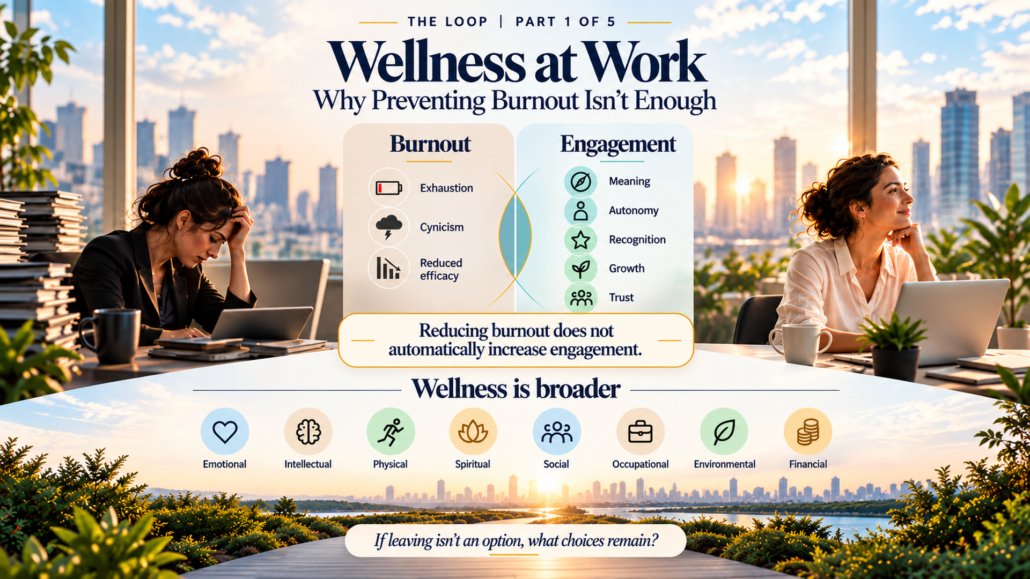
The World Health Organization (WHO) defines burnout as an occupational phenomenon resulting from chronic workplace stress that has not been successfully managed. It has three dimensions:
- Exhaustion: Feeling depleted or drained.
- Cynicism or mental distance: Becoming increasingly negative about or detached from work.
- Reduced professional efficacy: Feeling less effective or accomplished.
Employee engagement, on the other hand, reflects how involved, motivated, and connected people feel toward their work and workplace.
Can someone be disengaged without being burned out? Absolutely. Consider these four different type of employee experiences:

(https://community.thriveglobal.com/there-is-more-to-the-job-experience-than-just-burnout/)
What does this mean for organizations?
These distinctions matter.
Reducing burnout does not automatically increase engagement.
Preventing burnout requires addressing excessive demands, insufficient resources, and chronic workplace stressors. Improving engagement also requires meaning, autonomy, recognition, trust, growth, and opportunities to contribute. And workplace wellness encompasses even more.
Wellness at Work: Beyond Individual Responsibility
My dear friend and former colleague John Nesheim explores this broader perspective in his book, Wellness at Work: The New Strategic Imperative.

His work raises a question I believe every organizational leader should consider:
How much of what we ask individuals to manage is actually created by the system around them?
Here are five important takeaways and reflections from his work.
1. Wellness is a business strategy, not a collection of benefits.
Organizations significantly influence workloads, structures, management behaviors, resource allocation, incentives, and culture. Offering wellness programs alone without examining these conditions may address the symptoms, not the underlying causes.
2. Wellness is multidimensional and interconnected.
John introduces the Wellness Wheel, encompassing eight dimensions: emotional, intellectual, physical, spiritual, social, occupational, environmental, and financial. Employees bring their whole selves to work. You can’t understand their well-being through a single measure, whether engagement, stress, or physical health.
3. Organizations must move from reactive interventions toward prevention.
A 2024 study by Dr. William Fleming for more than 46,000 UK workers found that employees who participated in common individual-level wellbeing programs, including mindfulness and resilience training, generally reported no better wellbeing than nonparticipants. Individual resilience matters. But asking exhausted employees to become more resilient while maintaining the conditions that exhaust them is not a sustainable solution.
4. Culture is demonstrated through everyday leadership behaviors.
How leaders respond to feedback, manage competing priorities, recognize contributions, and build trust often reveals more about workplace wellness than formal policies. People need more than compensation and job security. They also need to feel that their work matters.
5. Awareness must translate into action.
Organizations need to understand their current state, identify opportunities, take meaningful action, and measure progress. Sustainable performance depends on protecting people’s capacity to contribute while creating conditions that allow them to thrive.
Where Does This Leave Us?
Workplace wellness isn’t simply about helping employees feel less stressed.
It’s about creating an environment where people can remain healthy, engaged, productive, and connected to meaningful work. Organizations cannot make every employee happy or eliminate every source of stress. But they can influence the conditions that either support or undermine people’s well-being.
What’s more challenging in your organization in today’s world? and What gives you energy at work these days?
And that brings us back to the question that started this conversation. If the organization doesn’t change soon, what can an individual do? –> Next week, Part 2: Individual Agency- Making choices when leaving isn’t possible